
Quick Answer: What are the Key Performance Indicators (KPIs) for Generative Engine Optimization (GEO)?
TL;DR: GEO KPIs measure how well your content performs in AI-driven search results. Focus on visibility metrics like AI-SERP impression share and brand mention frequency, content quality indicators such as fact density and citation frequency, user engagement metrics including AI-driven traffic and conversion rates, and technical factors like structured data implementation. These metrics help you understand and optimize your content’s performance across AI-powered search platforms like Google’s AI Overviews, ChatGPT, and Perplexity.
What is Generative Engine Optimization (GEO)?
Generative Engine Optimization (GEO) represents a fundamental shift in how we approach search optimization. Unlike traditional SEO that focuses on ranking web pages in search results, GEO involves optimizing content to be understood, extracted, and cited by AI-powered search engines and large language models (LLMs).
According to industry experts, “Generative engine optimization — shortened to GEO — is the craft of making your content visible inside the synthesized answers produced by AI-driven platforms like Google’s AI Overviews, Perplexity, ChatGPT Search, Claude, or Gemini.” – SEO PowerSuite
The key difference between GEO and traditional SEO lies in their objectives. While SEO aims to rank pages in traditional search results, GEO focuses on becoming the source of truth for AI-generated answers. This means your content needs to be structured, authoritative, and easily parseable by AI systems that synthesize information from multiple sources to create comprehensive responses.
The rise of AI-driven search is fundamentally changing how people consume information. Instead of clicking through multiple search results, users increasingly rely on AI-generated summaries and answers that pull information from various sources, making visibility within these AI responses crucial for maintaining online presence and authority.
Why are GEO KPIs Important?
Traditional SEO metrics like organic sessions, keyword rankings, and click-through rates are becoming insufficient in the AI-driven search landscape. These metrics don’t capture how your content performs when it’s being synthesized and referenced by AI systems rather than directly visited by users.
Research reveals the dramatic shift occurring in search behavior. According to recent studies, roughly 60% of searches now yield no clicks at all, as AI-generated answers satisfy user queries directly on the search results page – Forbes. This statistic underscores why measuring success in the AI era requires entirely new approaches to performance tracking.
GEO KPIs provide crucial insights into how effectively your content is being utilized by AI systems. They help you understand whether your content is being recognized as authoritative, whether it’s being cited correctly, and how it’s contributing to AI-generated responses. This data-driven approach enables you to make informed decisions about content strategy, identify optimization opportunities, and adapt to the evolving search landscape.
Moreover, GEO KPIs enable data-driven decision making by providing concrete metrics for evaluating AI optimization efforts. Without these specialized measurements, businesses risk investing in content strategies that may not align with how AI systems actually process and utilize information.
Key GEO KPI Categories & How to Measure Them
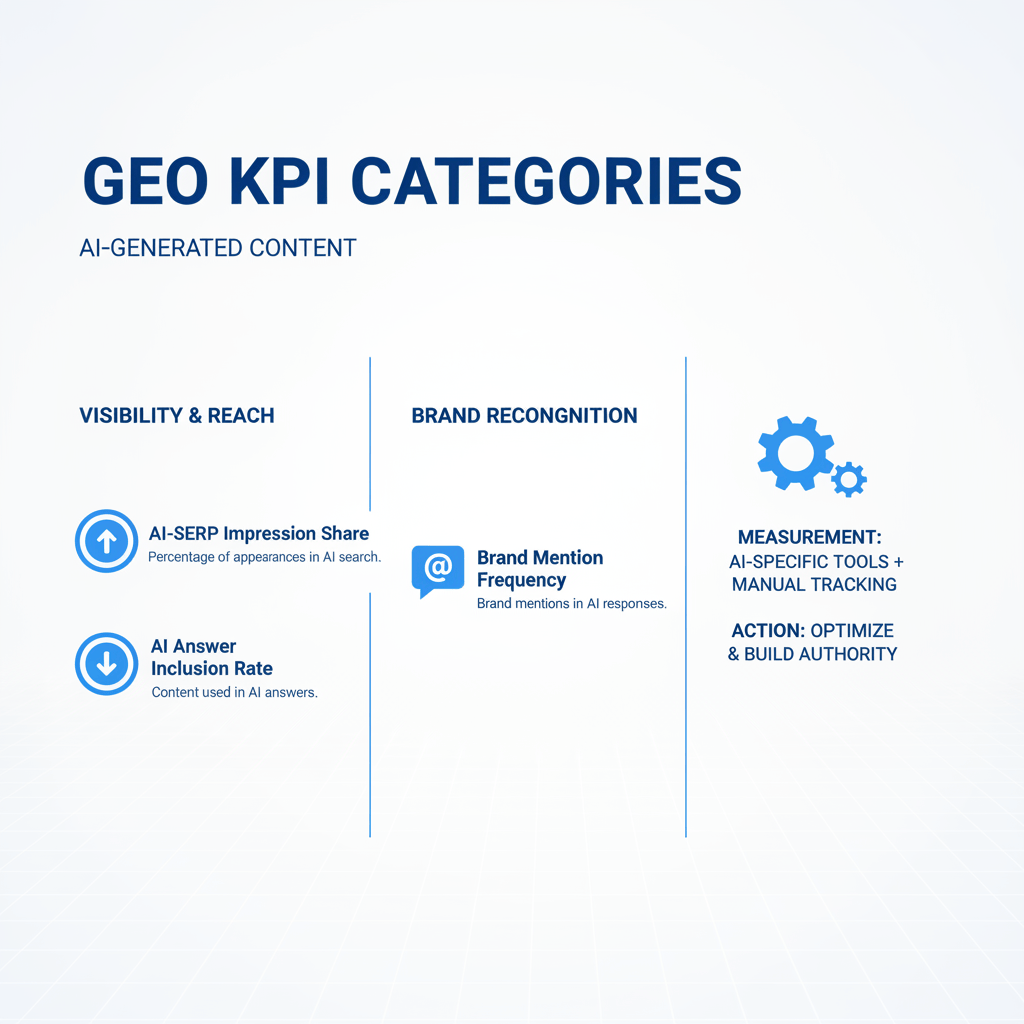
Category 1: Visibility & Reach in AI-Generated Content
AI-SERP Impression Share measures the percentage of times your content appears in AI-generated search results for relevant queries. This metric is crucial because it indicates your overall visibility in AI search environments. To measure this KPI, you’ll need AI-specific SERP tracking tools that are currently emerging in the market. The actionable insight here is to continuously optimize your content for relevant keywords and search intents that align with how AI systems interpret and categorize information.
AI Answer Inclusion Rate tracks the percentage of times your content is included in AI-generated answers when it’s contextually relevant. This metric directly indicates how well AI systems recognize and utilize your content as a credible source. Currently, this requires manual tracking of AI responses for your target queries across different platforms. To improve this rate, focus on enhancing content quality, relevance, and structural clarity.
Brand Mention Frequency in AI Responses counts how often your brand appears in AI-generated answers. This KPI measures brand awareness and recognition within AI search ecosystems. You can track this using brand monitoring tools that specifically monitor AI responses across various platforms. To increase brand mentions, focus on building brand authority and creating content that naturally incorporates your brand in contextually relevant ways.
Category 2: Content Quality & Authority
Fact Density Score quantifies the number of verifiable facts and credible sources within your content. AI systems prioritize accurate, well-sourced information, making this metric essential for GEO success. You can measure this by manually counting facts and sources or using emerging AI-powered content analysis tools. The key insight is to consistently increase the factual density of your content while maintaining readability and engagement.
Topical Authority Score measures how comprehensively your content covers specific topics. AI systems favor content from sources they recognize as authoritative on particular subjects. SEO tools that analyze topical coverage can help measure this metric. To improve your score, create comprehensive content that addresses all aspects of your target topics, demonstrating deep expertise and knowledge.
Citation Frequency by AI tracks how often AI models cite your content as a source in their responses. This metric indicates the trustworthiness and authority AI systems assign to your content. You can measure this by tracking mentions and backlinks from AI-generated content across various platforms. Focus on creating high-quality, original research and insights that naturally earn citations from AI systems.

Category 3: User Engagement & Conversions from AI-Driven Traffic
AI-Driven Traffic measures the number of users who visit your website after encountering your content in AI-generated responses. This metric directly indicates the effectiveness of your GEO efforts in driving actual website visits. Track this using referral traffic data from AI platforms in Google Analytics, setting up specific UTM parameters when possible.
Conversion Rate from AI Traffic calculates the percentage of AI-driven visitors who complete desired actions like purchases, sign-ups, or downloads. This metric is crucial for measuring the ROI of your GEO investments. Monitor this through conversion tracking in Google Analytics, segmenting AI traffic sources. Optimize your landing pages and user experience specifically for visitors coming from AI-generated responses.
Engagement Metrics from AI Traffic including time on page and bounce rate, reveal how well your content meets the expectations set by AI-generated summaries. These metrics indicate content quality and relevance from the user’s perspective. Track these metrics specifically for AI-driven traffic segments to identify opportunities for content improvement and user experience optimization.

Category 4: Technical GEO KPIs
Structured Data Implementation measures your use of schema markup to help AI systems understand your content structure and context. This technical factor significantly impacts how AI systems can extract and utilize your content. Use Google’s Rich Results Test and other schema validation tools to measure implementation completeness. Implement comprehensive schema markup across all relevant pages to improve AI comprehension.
Site Speed & Accessibility for AI Crawlers evaluates how quickly your website loads and how easily AI systems can access your content. AI systems prioritize fast, accessible websites when gathering information. Measure this using Google PageSpeed Insights and accessibility testing tools. Optimize your website’s technical performance to ensure AI systems can efficiently crawl and index your content.
Pages Indexed in AI or Vector Presence tracks how many of your pages are successfully indexed by AI systems or have vector embeddings created. As one industry expert notes, “LLMs are crawling sites and making recommendations based on how well they can parse your structured data. If yours is incomplete or messy, you’re invisible.” – 9Sail – JDSupra. This emphasizes the critical importance of technical optimization for AI visibility.

Tools and Techniques for Measuring GEO KPIs
The landscape of GEO measurement tools is rapidly evolving. Emerging AI-specific analytics platforms are beginning to offer specialized tracking for AI search performance, though many are still in development phases. These tools focus on monitoring AI-generated content across multiple platforms and tracking your content’s inclusion in AI responses.
Existing SEO tools can be adapted for GEO measurement with creative approaches. Tools like verbatune.com, SEMrush, Ahrefs, and Screaming Frog can be configured to track AI-related metrics, though they require manual setup and interpretation. Google Analytics remains crucial for tracking AI-driven traffic and conversions when properly configured with UTM parameters and custom segments.
Log file analysis offers unique insights into AI content extraction that traditional analytics miss. By analyzing server logs, you can identify when AI crawlers access your content, which pages they prioritize, and how frequently they return. This data provides valuable insights into AI behavior that complement standard analytics data.
Actionable Strategies for Improving Your GEO KPIs
Optimizing content for AI models requires a fundamental shift in content creation approach. Focus on writing clear, concise, and factual content that AI systems can easily parse and understand. Implement comprehensive structured data and schema markup to provide context and meaning to your content. Create comprehensive content that thoroughly covers topics from multiple angles, as AI systems favor authoritative, complete sources.
Building brand authority and trust becomes even more critical in the AI era. Create high-quality, original content that naturally earns citations from AI systems. Focus on earning backlinks from reputable websites and establishing thought leadership in your industry. Maintain consistency in your expertise demonstration across all content touchpoints.
According to HubSpot’s research team, “In the past 6 months, we’ve been doing a lot of testing around optimizing our brand for generative engine optimization. We’ve noticed how AI-driven search tends to pull in content that’s extremely structured via bulleted lists, structured headings, and general listicle-style articles.” – HubSpot Blog. This insight highlights the importance of content structure in GEO optimization.
Monitoring and adapting to changes in AI algorithms requires continuous vigilance. Stay updated on developments in AI-driven search platforms, regularly monitor your GEO KPIs, and be prepared to adjust strategies based on performance data. The AI landscape evolves rapidly, making adaptability crucial for long-term success.
The Future of GEO and its Measurement
The future of AI-driven search promises even more sophisticated integration of AI responses into search experiences. Emerging trends suggest increased personalization of AI responses, multimodal search capabilities combining text, voice, and visual elements, and more nuanced understanding of user intent and context.
Industry predictions indicate significant changes ahead. Gartner predicts a 50% drop in organic search by 2028 due to AI search – FirstMotion. This dramatic shift underscores the importance of preparing for an AI-dominated search landscape.
The importance of continuous monitoring and adaptation cannot be overstated. GEO KPIs will continue evolving as AI systems become more sophisticated and new platforms emerge. Organizations must remain flexible and responsive to these changes while maintaining focus on fundamental principles of quality, authority, and user value.
SEO professionals must expand their skill sets to include understanding of AI systems, prompt engineering, and technical implementation of AI-friendly optimizations. The future belongs to those who can bridge traditional SEO expertise with AI-era optimization strategies.
Conclusion: Embrace GEO KPIs to Dominate AI-Driven Search
The key GEO KPIs outlined in this guide provide a comprehensive framework for measuring and optimizing your content’s performance in AI-driven search environments. Focus on visibility metrics, content quality indicators, user engagement data, and technical optimization factors to build a robust GEO strategy.
Taking action on GEO optimization is no longer optional—it’s essential for maintaining competitive advantage in the evolving search landscape. Start by implementing measurement systems for the most critical KPIs, then gradually expand your tracking and optimization efforts as tools and techniques mature.
The future of search is undeniably AI-driven, and organizations that embrace GEO principles today will be best positioned for tomorrow’s challenges. By focusing on creating high-quality, structured, authoritative content that serves both human users and AI systems, you can maintain and grow your digital presence in the age of generative AI. Tools like Verbatune.com can help streamline this entire process so you can get cited in days.
Frequently Asked Questions
What is the difference between SEO and GEO?
SEO focuses on ranking web pages in traditional search engine results, while GEO optimizes content to be understood, extracted, and cited by AI-powered search engines. SEO aims for page visits, while GEO targets inclusion in AI-generated answers and responses.
What are the most important GEO KPIs to track?
The most critical GEO KPIs include AI-SERP impression share, brand mention frequency in AI responses, citation frequency by AI systems, AI-driven traffic, and structured data implementation. These metrics provide comprehensive insights into your AI search performance.
How can I measure GEO KPIs?
Measure GEO KPIs through a combination of emerging AI-specific analytics platforms, adapted traditional SEO tools, manual tracking of AI responses, and log file analysis. Many measurements currently require manual processes, though automated tools are rapidly developing.
What tools can I use to track GEO performance?
Current tools include adapted SEO platforms like SEMrush and Ahrefs, Google Analytics for traffic tracking, schema validation tools, and emerging AI-specific monitoring platforms. Manual tracking across AI platforms remains necessary for comprehensive measurement.
How can I improve my GEO KPIs?
Improve GEO KPIs by creating structured, factual content with comprehensive topic coverage, implementing schema markup, optimizing site speed and accessibility, building topical authority, and continuously monitoring AI algorithm changes. Focus on quality and technical excellence.
Is GEO just a fad, or is it here to stay?
GEO is a permanent shift in search technology. With predictions of 50% reduction in traditional organic search by 2028 and 60% of current searches yielding no clicks due to AI answers, GEO represents the future of search optimization rather than a temporary trend.
How do I optimize for different AI models?
Different AI models have varying preferences for content structure and sources. Focus on universal principles like factual accuracy, clear structure, comprehensive coverage, and proper technical implementation. Monitor performance across multiple AI platforms and adjust strategies based on platform-specific results.
What is the role of structured data in GEO?
Structured data is crucial for GEO success as it helps AI systems understand content context, relationships, and meaning. Proper schema markup implementation significantly improves the likelihood of content inclusion in AI-generated responses and enhances accuracy of AI interpretation.